India’s Strategic Gambit: Becoming the Third Pole in a Bipolar World
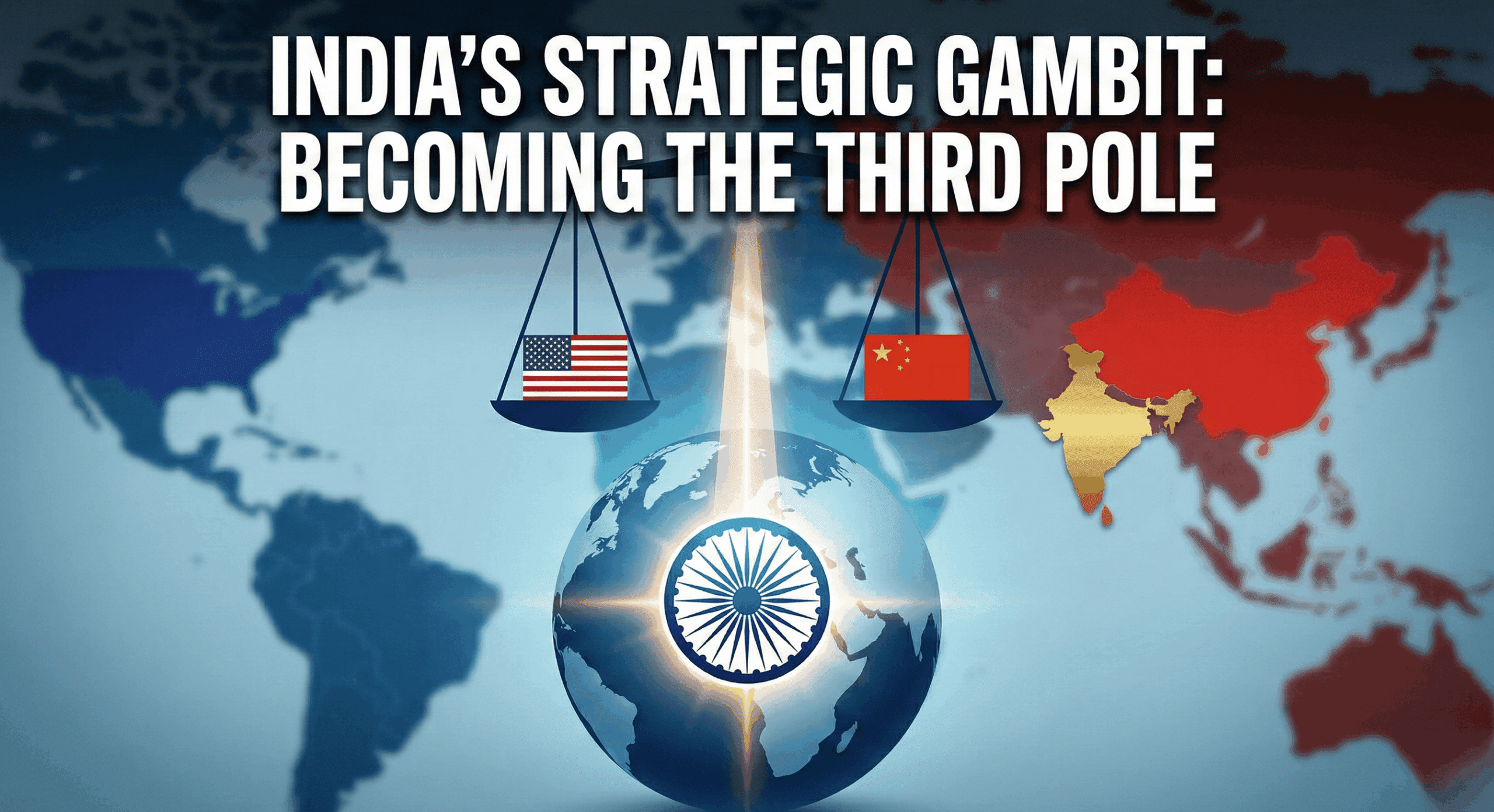
India is working to be seen as the “third option” between the US and China. Learn how Modi’s government balances relationships with superpowers while aiming for independence in 2025.
Introduction: The Emergence of Multiple Alignments
As tensions between the US and China shape global politics, India is taking its own path. Instead of picking a side in this new Cold War, New Delhi is striving for what experts call “strategic autonomy”—making itself an independent power or “third option” in global affairs. This bold plan could change the international landscape but needs careful handling of conflicting interests and complexities.
The Balancing Act: Friends with Everyone, Allies with Nobody
India’s approach as a third option relies on building strong connections with both the US and China without becoming dependent on either. This strategy gives India a lot of freedom, but it also brings some tough challenges.
With the United States, India has boosted defense cooperation through the Quad partnership (with Japan and Australia), increased joint military drills, and signed key defense agreements. American companies are pouring billions into India’s manufacturing as they look for options other than China. The US sees India as an important ally to limit China’s power in the Indo-Pacific region.
With China, even with ongoing border disputes and the deadly clash in Galwan Valley in 2020, India keeps strong economic links. Recently, trade between the two countries surpassed $100 billion, and India relies on China for electronics, medicine, and manufacturing supplies. Completely separating from China is not a realistic option.
With Russia, India sticks to its long-standing partnership despite pressure from the West. It has bought discounted oil from Russia during the Ukraine conflict, upheld its “special relationship” with Moscow, and continues to depend on Russian military equipment. This shows that India is committed to making its own decisions without following Western expectations.
Why Independence Matters
India’s choice not to fully align with either superpower showcases both its historical views and smart thinking in today’s world.
Historical roots:
The founders of India believed in non-alignment during the first Cold War. India actively collaborates with major countries rather than standing back, and the idea of strategic independence still holds significant value culturally.
Economic needs:
India requires investments, technology, and access to markets from the West to meet its development goals. At the same time, it cannot risk a conflict with China or lose Russian support for defense before having a local solution.
Regional leadership:
By acting independently from the big power groups, India attracts countries in the Global South looking for alternatives to the US and China. This boosts India’s reputation as a leader in groups like the G20 and BRICS.
The Contradictions and Challenges
India’s plan to be a significant player on the world stage has many serious challenges that might hurt its chances of success.
The issue with China:
Disputes over borders, claims to land, and competition for power make it really tough for India to stay neutral between the US and China. As things get more tense, both of these powerful countries will push India to make a clear choice.
Economic dependencies:
India has a trade gap with China and relies on Russia for its defense, which limits what it can do. If India doesn’t quickly modernize its economy and military, it risks staying dependent on countries it wants to balance against.
Domestic capacity gaps:
For India to really act as a strong third player, it must achieve significant economic growth, improve its technology, and build up its military strength. There are still doubts about whether India can grow enough to truly compete with the US and China’s global influence.
Trust deficits:
Both the US and China doubt India’s reliability as a partner since it won’t fully commit to either side. This might lessen the benefits India could gain from each relationship.
The Path Forward
For India to succeed as a third choice, it relies on several factors. It needs to keep making economic reforms to attract investment from around the globe, lessen its reliance on Chinese goods through local production, ensure it can deter Chinese threats, and make the most of its democratic values and cultural influence.
This strategy also demands skilled diplomacy to handle the inevitable tensions that arise when Indian interests clash with those of superpowers, which often happens on topics like Russia, climate change, and trade.
Conclusion: A High-Stakes Strategy
India’s efforts to position itself as an independent player in world politics is one of the boldest geopolitical strategies of this century. If successful, it would give India extraordinary power and create a more balanced world. If it fails, India could end up isolated, vulnerable economically, and exposed strategically.
As the rivalry between the US and China grows stronger, the world is watching to see if India can truly find a way between these giants, or if the pressure to pick a side will become too strong to resist.