
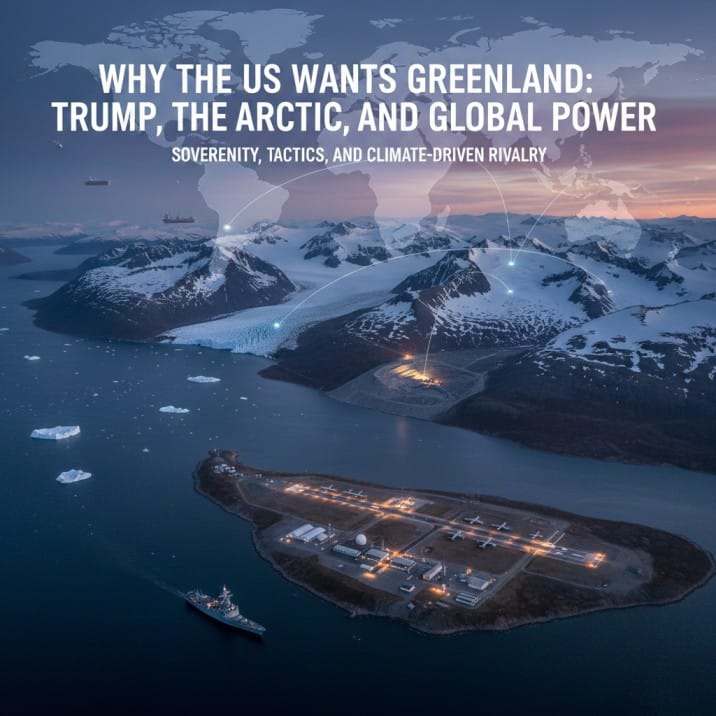
Why the US Wants Greenland: Trump, the Arctic, and Global Power
The notion of the United States purchasing Greenland has come back to international headlines in 2025, therefore re-opening a discussion combining sovereignty, tactics, and climate-driven rivalry. Turning the focus to the Arctic as a major stage of twenty-first century geopolitics once more, Donald Trump has expressed interest in increasing American control over the world’s biggest island. Although the plan seems strange, the reasons behind it—military strategy, resource security, and great power rivalry—are profoundly ingrained.
Beyond headlines, understanding why Washington is concentrating on Greenland demands investigation of the structural changes changing the Arctic. The area has gone from a frozen border to a strategic priority as a result of melting ice, new shipping lanes, and growing rivalry with other countries.
Why Is the US interested in Greenland?
American interest in Greenland is essentially geographical. Acting as a natural bridge over the North Atlantic and the Arctic, the island lies between North America and Europe. This placement greatly increases its utility for power projection, defense, and surveillance. The United States realized this benefit in World War II and developed a military presence that has never entirely vanished.
The strategic thinking today has just grown more severe. Access to the area is becoming simpler as Arctic ice melts, hence managing important nodes is becoming more and more crucial. One of those nodes is Greenland, which is therefore vital for any long-term Arctic plan.
Strategic Military Value of Greenland
America’s most northern military installation, Thule Air Base, a vital component of NATO and US defense infrastructure, is located in Greenland. Early-warning radar systems, space monitoring, and missile detection capabilities meant to guard North America are supported by the basis.
From Greenland, the United States can follow missile launches, monitor Arctic airspace and maritime routes, and view military activity by other nations. Greenland’s function as a listening post and protective shield grows ever more important as Russia and China enlarge their Arctic aspirations.
Economic Value and Potential Resources
Military factors make up only a little of the overall equation. Greenland is also endowed with natural resources more and more essential for modern economies. Deposits of rare earth minerals vital for cellphones, electric vehicles, renewable energy sources, and sophisticated weapons systems lie beneath its rock and ice. Uranium, zinc, and possible oil and gas reserves also found on the island are getting easier to reach as temperatures increase.
Washington sees access to these resources as a way to lower reliance on Chinese supply networks, a big issue in the middle of growing technological rivalry. In an age marked by strategic minerals, control or impact over the growth of Greenland could improve American economic security.
Opposing Chinese and Russian Dominance
The revived emphasis on Greenland is intertwined with questions about China and Russia. Heavy military presence by Russia along its Arctic coast has seen the reopening of Soviet-era bases and deployment of cutting-edge equipment to safeguard energy projects and transportation channels. Calling itself a “near-Arctic state,” China has poured funding into regional mining and infrastructure initiatives.
Increased American participation in Greenland would serve as a counterbalance, thereby bolstering Western presence and restricting the strategic space open to opponents in the High North.
Greenland looks at things from two angles: Independence and Chance
In this discussion, Greenland’s around 57,000 people are not mute observers. Broad independence for the island exists from Denmark; many Greenlanders still hope for independence one day. Stressing self-determination over outside agreements, local leaders have repeatedly stressed Greenland is not for sale.
Greenland also depends rather much on fishing and yearly Danish subsidies. Often regarded as leverage to draw in money, diversify the economy, and progressively toward more political and economic independence, worldwide interest—including from the United States—helps to
Europe, Denmark, and Allied Politics
Though calmly but forcefully, Denmark has reacted to revived American curiosity emphasizing that Greenland’s destiny only rests in Greenlanders’ hands. With the European Union paying great attention, the problem also resonates across Europe. Though transatlantic harmony is still crucial, European leaders are wary of any example that seems to view land as a product.
What Next?
Numerous outcomes are feasible. Deep collaboration without a change in sovereignty—including greater US investment, expanded military cooperation, and joint resource projects—is most likely. Still open but politically difficult are more extreme ways including Greenlandic independence supported by American financial aid. Alternating tension and bargaining might also help to preserve the present state.
The grander picture of the Arctic
The discussion over Greenland reflects broader Arctic patterns. Increasing rivalry for resources and roads, climate change is putting strain on cooperative structures like the Arctic Council. Balancing environmental protection, sovereignty, and security will become more and more challenging as competition intensifies.
In summary: Strategy Touches Sovereignty
The renewed US interest in Greenland reflects a defining conflict of modern geopolitics. While concepts of sovereignty and self-determination fight against easy fixes, strategic logic and economic incentives move great powers northward. The way this equilibrium is achieved in Greenland will determine not just Arctic politics but also the future norms of rivalry in a changing, more fought-over globe.